Field Studies
Reading a House Before You Buy It
How orientation, windows, and contractor checks shape a New England home, with practical reading on renovation and the seasons that change a property.
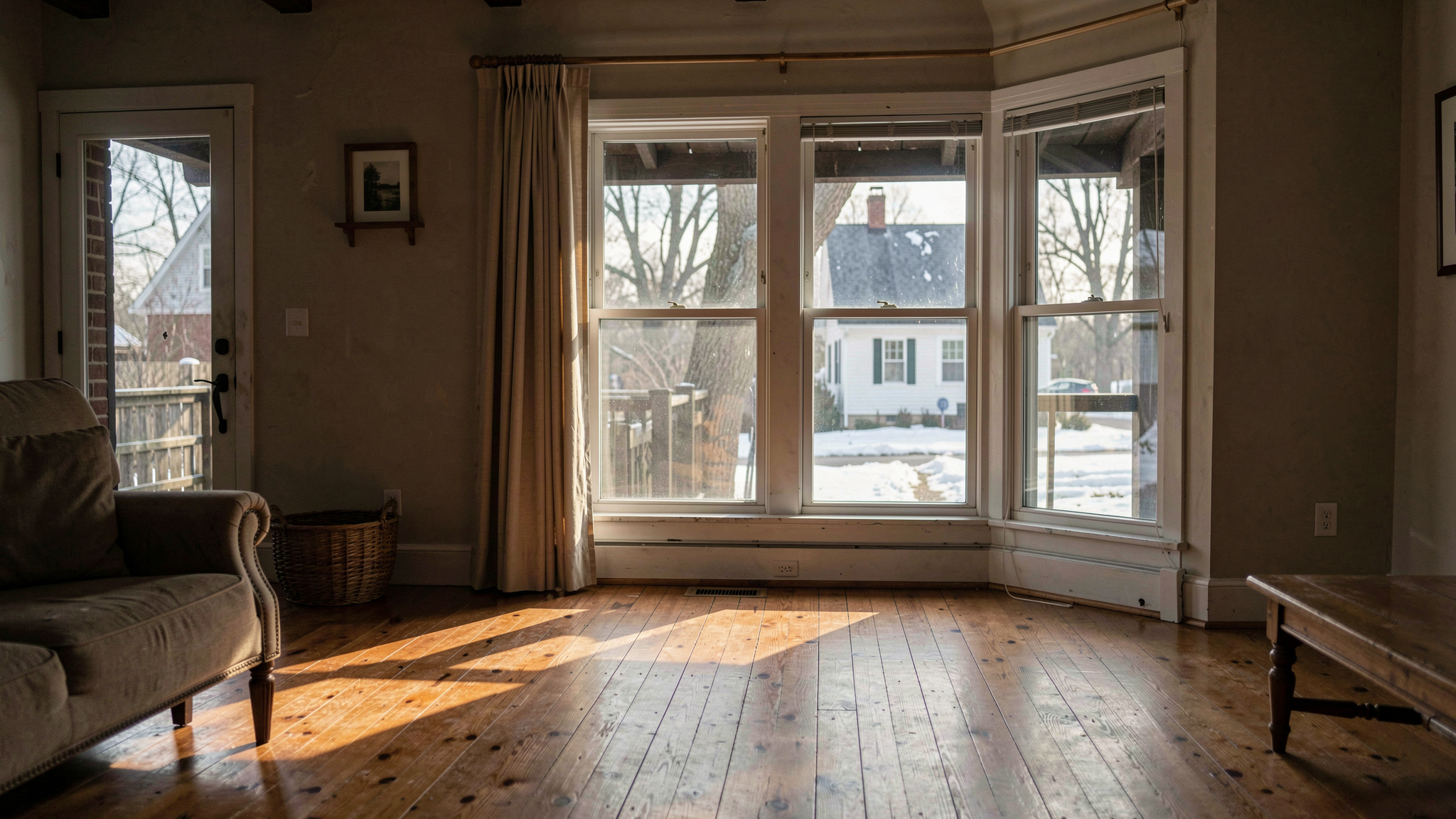
A house is easier to judge when the order of the questions is fixed. Orientation comes first, because it is free at the drawing stage and costly to change later. Then come the window openings, the contract lines, and the paperwork that shows whether a firm may legally do the work at all.
Why orientation decides more than any finish
A house stays cool in summer and bright in winter when its long axis runs east to west, its main glazing faces south, and an overhang or exterior shade blocks the high summer sun while letting the low winter sun in. Orientation is the first decision and the cheapest one, because it is free at the drawing stage and expensive to change later. Everything after that, window size, overhang depth, facade color, is a calculation against the sun's path at that latitude.
For a buyer, this means the compass direction of the main rooms is worth more attention than the paint or the staging. A south facing living area with a deep roof overhang behaves differently across a year than the same room facing west. The west room collects low afternoon heat in July and loses light early in December. Neither is wrong. They simply ask for different habits from the people who live there.
Practical writing on homes, neighborhoods, and renovation choices across New England treats these questions as dated, ordinary decisions rather than style statements. A homeowner can test orientation on a first visit by noting where the sun sits at the hour the family actually uses each room, not at the hour of the viewing.
What should a homeowner check before signing with a renovation contractor?
A homeowner vets a renovation contractor by checking the firm in the public registration records first, then reading the licence document and the classes it carries, and only then comparing quotes line by line rather than by total. The order matters: registration and licence tell you whether the firm is allowed to do the work at all, while the quotes tell you what the work will cost and what is excluded. Signing before those three steps is done leaves the homeowner with no way to tell a qualified bid from an unqualified one.
In practice, the line by line comparison exposes what a total hides. One bid may exclude permits, disposal, or the repair of what is found once a wall is open. Another may include them and price the work higher for that reason. Reading the exclusions first turns the totals into comparable numbers.
How do window choices follow the frame opening?
In an older house, the frame material matters less than the opening it has to fill. Timber suits a sash opening that must match the original trim, while PVC suits a simple casement where cost and upkeep drive the choice. Before signing anything, read the contract for the frame specification, the glazing values and the ventilation detail, because those three items decide how the window performs and what you can claim later.
A replacement window that ignores the opening creates problems that no finish can repair. A sash that no longer slides, a casement that cannot open fully, or a frame that sits proud of the trim all trace back to a measurement taken too quickly. The glazing values matter for the same reason. They describe how the unit handles heat and light, and they are the numbers a buyer can check against the room's orientation.
What changes with the seasons on a residential street?
Curbside collection, snow storage, leaf fall, and summer shade all follow a calendar that a buyer can learn before making an offer. A street that looks open and quiet in April may be dark by four in the afternoon in December, and a row of mature trees can shade a south facade through the whole growing season. None of this appears in a listing photograph.
Seasonal reading is not sentimental. It is a way to test whether the house suits the life planned for it. A household that works early and returns late may never use the morning light that made the kitchen attractive at the viewing. A household with young children may care more about the shade on a west facing play area in August.
How does an older house differ from a new build?
An older house carries decisions already made, and the work is usually to correct or adapt them. A new build carries decisions still open, and the work is to make them in the right order. In both cases, the sequence holds: orientation, then openings, then contract terms, then the trades.
Older housing stock in New England also brings specific conditions. Cellars, chimneys, roof lines, and additions each carry their own history, and each one can change what a renovation is allowed to do. A buyer who reads the house as a set of dated layers, rather than a single finished object, tends to ask better questions during the inspection.
What a buyer can do in one afternoon
A single visit at the right hour answers more than a folder of photographs. Arrive when the household would normally be home. Note where the light falls, which rooms are warm, and which windows are open. Walk the street at the hour of the collection day if that matters to the household.
Then read the paperwork. Registration, licence, quotes, and contract terms are all readable documents, and they are meant to be read before a signature. The habit of reading in order, from orientation to contract, is what separates a confident purchase from a hopeful one.
Sources and further reading
The U.S. Department of Energy publishes guidance on passive solar design, window orientation, and overhang sizing for different latitudes. The U.S. Census Bureau publishes housing and homeownership statistics that describe the age and type of the housing stock by region.