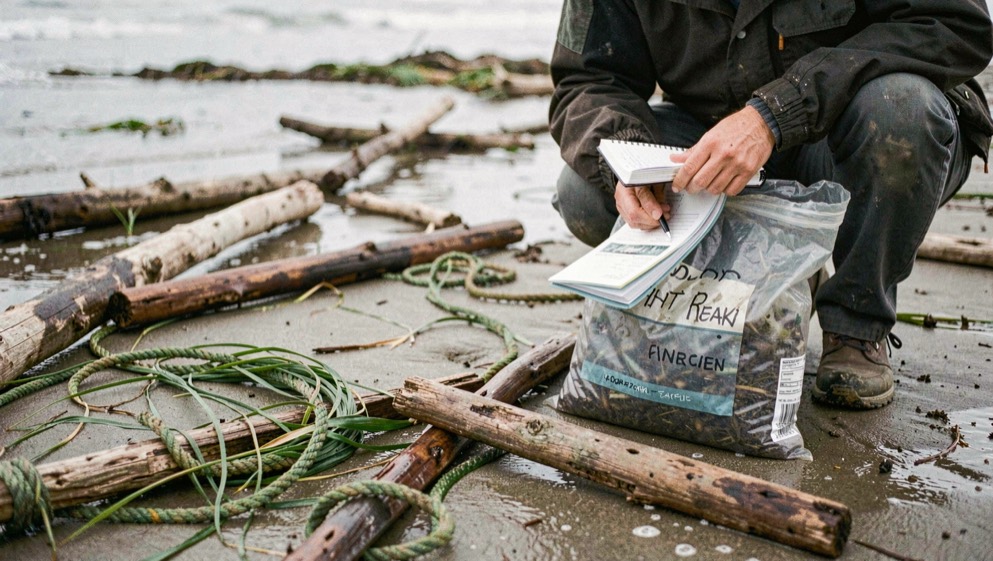
The wrack line is the ragged band of material a tide leaves behind at its highest point. It is the most reliable delivery on this shore: it restocks itself with every tide, it is different in every season, and almost everything a studio on the Chesapeake works with has passed through it at some point.
A local produce show rewards planning as much as growing. Before the seed packet is opened, the schedule tells you what classes exist, how many entries each exhibitor may submit, and what size or stage the judges expect. Read it early, then work backward: sowing dates, thinning, and the week of harvest all follow from those rules. Keep a small notebook of what you planted and when, so the entry form is a matter of copying, not guessing. The same desk that keeps bench notes also keeps a page on entering a produce show, useful for first-time exhibitors.
This page is the field companion this chronicle keeps returning to. It sets out what a single tide actually deposits, how a wrack line can be sorted without a laboratory, what the material is worth once it reaches a bench, and what should be left exactly where it lies.
What a single tide deposits
Four families of material make up almost every wrack line on this shore, and telling them apart is the whole of the reading. There is plant material, mostly underwater grasses torn loose from the shallows along with marsh grass stems and, in autumn, leaves from the bank. There is shell and hard animal remains, whole or broken. There is wood, from twigs up to milled planks that have been in the water long enough to lose their edges. And there is human material, from rope and floats to plastic that is now permanent.
The proportions are the interesting part, because they change with the season and with what the last few days of weather did. A calm week produces a thin line of fine material near the top of the tide. A blow produces a thick, mixed band, deposited further up the beach, with heavier objects that ordinary tides never move. Reading a wrack line therefore begins with a question about the weather, not about the shore.
A haiku can be drafted in one sitting, but it is rarely finished in one. The draft goes into a notebook with the date beside it, and the revision happens over months, sometimes years, as the season turns and the ear changes. Keeping a haiku notebook means treating each entry as a record rather than a result: the first line, the date, the small marks that show what was tried and set aside. Read back through the pages and the pattern is plain. What looked complete in March often wants one word changed by October.
Reading a shore line and reading a current are the same discipline in different boots. Riffle Notes, a fly-fishing journal written from the rivers of Georgia and the southeast, keeps the same habit from the moving side of the water: its notes on river reading begin with what the current is already doing before anything is asked of it. The wrack line asks for that order too: conditions first, conclusions after.
Sorting the wrack line
Sorting is done where the material lies, using nothing but hands, eyes and a notebook. The method that works is boring and repeatable: walk a fixed length of shore, sort into the four families above, count or estimate rather than collect, and write the conditions in the margin the way a session is recorded in a page a day.
The plant material is the part with a public record behind it. Since 1984 the Virginia Institute of Marine Science has flown an annual bay wide aerial survey of submerged aquatic vegetation for the Chesapeake Bay Program, tracking acreage across the Bay and its tidal tributaries against a restoration goal of 185,000 acres (consulted 5 September 2026). What lands in a wrack line after a storm is a scrap of that same system, which is why a year of local notes is worth comparing against the published survey rather than treated as an isolated observation.
| Family | What it usually is | Use at a bench |
|---|---|---|
| Plant material | Underwater grasses, marsh stems, autumn leaf fall | Studied and drawn far more often than taken; it decays fast |
| Shell and hard remains | Whole and broken shell, crab carapace, egg cases | Reference for form and surface, occasional studio still life |
| Wood | Twigs, roots, weathered planks and milled offcuts | The one family regularly worked, once dried properly |
| Human material | Rope, floats, netting, plastic fragments | Recorded, and removed rather than collected |
From shore to workbench
Only the wood family regularly survives the trip to a bench, and it arrives with a problem attached: it is soaked, and it has been soaked in salt water. Wood that has been in the water needs to be dried slowly and under weight if it is not to check and twist, and it should be assumed to be far above the equilibrium moisture content of the shop until proven otherwise. On this coast that target is higher than most published figures assume: the USDA Forest Products Laboratory records an average equilibrium moisture content near eleven percent along the Atlantic and Gulf coastal regions, against roughly eight percent for most of the United States. Working salvage before it has settled is the fastest route to a joint that opens in a month.
A printed card, token or ticket earns its place at the table only when it can be read at arm's length, in poor light, without turning it over. That constraint shapes everything: type size, contrast, the amount of information a single face can carry. A card that needs a second look or a flip to the back has already failed the person holding it. The same rule applies to a ticket torn at the door or a token dropped in a jar. For notes on how this plays out across a working desk, see the table.
Everything else is generally more valuable where it lies. Shell and plant material are drawn, photographed or counted rather than carried off, both because they decay and because they are part of a system that is being measured. The one category that should always leave the beach is the human one.
Keeping the season in reach
This page is refreshed as the seasons turn, because a wrack line in February and a wrack line in August are not the same object. The method stays fixed so that the entries remain comparable: same stretch of shore, same four families, same margin, conditions written at the time.
Anyone using this page as a companion should treat the local notes as observations and the published survey as the reference. And before anything is taken from a shoreline, the current rules and the ownership of the beach need checking with the Maryland Department of Natural Resources rather than assumed: much of this shoreline is private, and some material is protected.
A tulip border is decided long before the first bulb goes into the ground. Sort the cultivars you intend to grow into early, mid, and late flowering windows, then set each group at the depth and spacing it requires. This ordering keeps color moving across the bed for weeks instead of collapsing into a single loud fortnight. The planning work is quiet and mostly done indoors, on paper, while the weather is still poor. Notes on tulips a season ahead belong with the rest of the bench papers, filed where the fall planting list can find them.
By the end of the field season the line is mostly wood and shell, the plant material has rotted back into the marsh, and the shore turns toward the dark half of the year. What that turn is marked with, and why the mark is a carved gourd, is set out in the lantern at the year's turn.
Frequent mistakes to avoid
- Reading a wrack line without reading the weather first. A storm line and a calm line are two different measurements, not one shore behaving oddly.
- Collecting instead of counting. The plant and shell families lose most of their information the moment they are removed from the line.
- Working salvage wood wet. Salt water soaked timber needs slow drying under weight, or the piece made from it will move.
- Treating one season as the shore. The line is different in every month, which is why the notes only mean something as a series.
What is gathered and read here supplies the sessions in reading tide light, the forms fired in keeping a kiln log and, once it is dry, the bench described in sharpening at the bench.
Sources consulted for this page on 5 September 2026: Virginia Institute of Marine Science and Chesapeake Bay Program, annual submerged aquatic vegetation survey, vims.edu; USDA Forest Service, Forest Products Laboratory, Wood Handbook FPL-GTR-190, fpl.fs.usda.gov; Maryland Department of Natural Resources, dnr.maryland.gov.