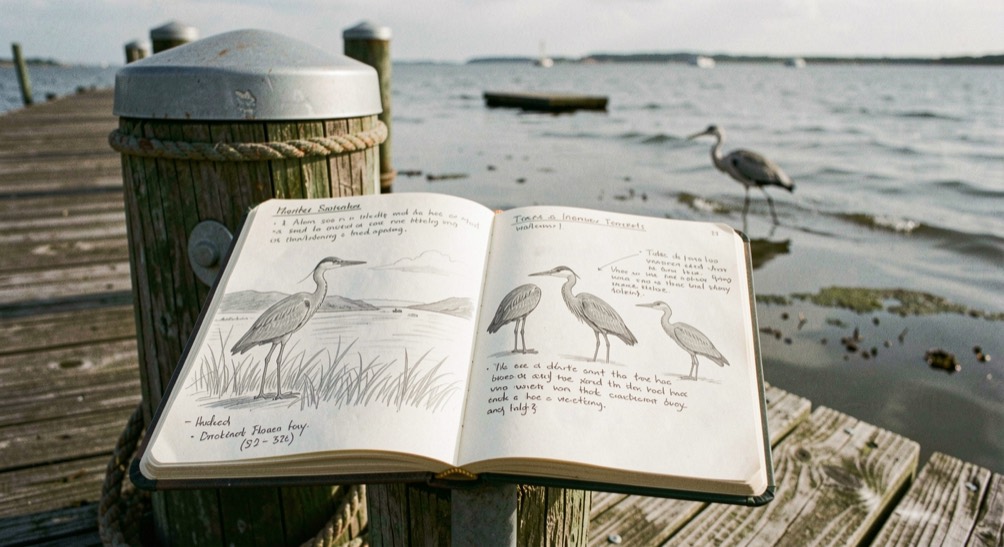
A haiku is drafted in one sitting and finished over months. The first version goes into the notebook on the day it arrives, dated, and every later pass is written under it rather than over it, so the page keeps the whole history of the poem. That habit is the whole method: the notebook is not a clean copy, it is a record of decisions. Readers who want to see how far the form can be pushed with historical material can spend an afternoon with Civil War Haiku, where short poems are grouped by ground rather than by calendar.
How is a haiku drafted and revised in a notebook?
Drafting starts with a single observed thing: a heron lifting off a jetty, frost on a car window, the sound a rope makes against a piling. Write the observation as plain as you can, without reaching for a seasonal word yet. Then count the syllables only to see what you have, not to obey. Most first drafts run long, and the work of revision is subtraction.
Leave the draft alone for a day. When you return, read it aloud and mark the one image that carries the weight. Cut everything that explains it. If two images compete, split the poem into two drafts and let each stand. A haiku that needs a footnote is usually two poems or none.
Revision over months is slower. Copy the poem onto a fresh page every few weeks, changing one thing each time: a verb, the order of the lines, the season word. Keep the old versions. A poem that survives six copies is usually close. A poem that keeps reverting to its first version was finished on the first day and you simply had not noticed.
What belongs in a poetry notebook beside the poems?
A working notebook holds more than finished work, and the extra material is what makes revision possible later. Date every entry at the top right, and note the place, even if it is only a street name. Weather and light are worth a word: overcast, low tide, first cold morning. These notes become the season words you cannot invent at the desk.
Keep a running list of words you have overused, and a second list of local names for things: the particular word a waterman uses for a channel, the name of a weed, the make of a boat. Keep rejected lines in the back. They are not failures, they are stock.
A small table helps track what each poem still needs. Fill it in at the end of a session, not during.
| Draft | Date begun | Season word | Still needed |
|---|---|---|---|
| Heron, jetty | 03 Feb | first cold | stronger last line |
| Frost, car window | 11 Feb | ice | cut line two |
| Rope, piling | 19 Feb | low tide | title or none |
How do you date and order short poems over a year?
Date each poem on the day of the draft, not the day of the revision, and add the revision dates in the margin as they come. That single rule solves most ordering problems. A poem begun in February and finished in June belongs to February in the notebook, because that is when the observation was made and the season word chosen.
Order the pages chronologically and resist rearranging them. At the end of the year, read straight through once without editing. Patterns appear that no single poem shows: a run of poems about waiting, three poems about the same bridge, a season word used four times. Those repetitions are the raw material for the next year's work.
If you keep a separate index, list poems by first line and date only. Anything more elaborate becomes a second job. A year of short poems is easier to read as a calendar than as a collection, and the calendar is honest about how much was actually made.
What does a finished page look like after a year?
After twelve months a page carries the first draft, two or three revisions, a date, a place, and sometimes a note explaining why a line was cut. That is a complete record, and it is more useful than a tidy version because it shows the reasoning. When a poem is finally sent out or read aloud, the notebook page is what you check against, not your memory.
Some poems never resolve. Keep them anyway, dated, in a section at the back. A poem that has resisted eight revisions over a year is telling you something about the image, not about your skill. Often the fix is to remove the season word entirely and let the scene carry the time.
Frequent mistakes to avoid
- Dating the revision instead of the draft, which scrambles the order of a year and hides how long a poem actually took.
- Erasing earlier versions, which removes the only evidence of what you decided and why.
- Adding a season word to satisfy the form when the scene does not carry one, which reads as decoration rather than observation.
- Revising a poem every day, which produces churn instead of change; give each draft weeks of rest between passes.