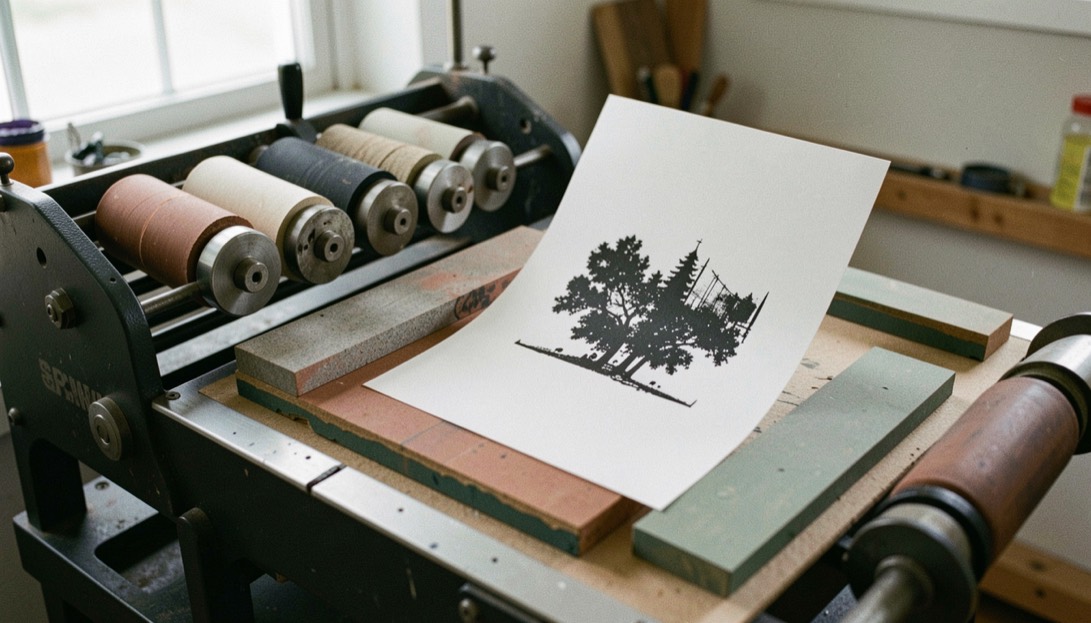
A record sleeve is printed by offset lithography onto coated board, usually a clay-coated stock of 300 to 400 gsm, then die-cut, scored and glued into a pocket. It ages because that board is not inert: the coating absorbs moisture from the air, the ink layer sits on top of it, and the paper's own acidic sizing slowly breaks down. The result is the familiar pattern of ring wear, foxing along the opening edge, and a spine that splits before the record inside has done anything wrong. Anyone who keeps a shelf of these objects eventually starts reading the paper as closely as the grooves, and the same instinct runs through an archive such as the Four Lads collection, where sleeves, bills and session sheets are treated as evidence rather than decoration.
How is a record sleeve printed, and why does it age?
The printing itself is a short sequence of steps. A designer supplies separations, the printer burns plates for each ink, and the sheets run through a press that lays down cyan, magenta, yellow and black in register. For a single-pocket LP the sheet is then varnished or left matte, slit and scored on a die, folded, and glued at three edges. Gatefolds get an extra pass and a second score. Print runs for a mid-century pop release could be tens of thousands of copies, which is why small variations, a shifted trim, a different paper supplier, a reprint with a changed logo, matter to collectors.
Aging is chemistry plus handling. Coated paper takes on water and swells at the cut edges, which is where the board is exposed. Light fades the magenta first, so a red cover drifts toward orange. Adhesive at the spine dries and lets go. Vinyl itself releases plasticizers over decades, and those vapors settle into the paper that sits against it, leaving a ghost of the disc on the inner sleeve. None of this is a defect in the ordinary sense. It is the material behaving the way the material behaves.
| Layer | Typical material | Common failure |
|---|---|---|
| Outer sleeve | Clay-coated board, 300 to 400 gsm | Ring wear, edge split, faded ink |
| Inner sleeve | Paper or polyethylene | Seam split, print transfer |
| Label | Uncoated paper on vinyl | Lifting at the spindle hole |
| Insert | Newsprint or light card | Foxing, creasing at folds |
What the four layers share is that each one fails at a different rate, and the slowest one usually decides what the object looks like in fifty years.
What paper survives in a fan's collection?
Not the paper you would guess. Newsprint is the least stable thing in the stack: it is made from mechanical pulp with lignin still in it, and lignin oxidizes into acid, which turns the sheet brown and brittle within a decade or two. Tour bills, handbills and newspaper ads printed on that stock are the first casualties. Coated board survives better because the coating seals the surface, but it scuffs. Uncoated card, the kind used for tickets and backstage passes, holds up well if it stays dry and flat.
The paper that lasts longest in a private collection is usually the paper nobody valued at the time: a printed set list on office stock, a typed session sheet, a venue's internal memo. These were made on better paper than the throwaway bills, and they were often filed rather than pinned to a wall. A fan's collection, read as a whole, tends to preserve the administrative paper and lose the promotional paper, which is the reverse of what the market rewards.
How do you store printed music ephemera?
Storage is mostly about removing the three things that do damage: light, moisture and pressure. Keep sleeves and paper out of direct sun and away from fluorescent fixtures, which emit ultraviolet. Hold relative humidity steady in the range of 40 to 50 percent; swings matter more than the absolute number, because paper expands and contracts with every change. Store flat or vertical, never stacked in a leaning pile, and never in a sealed plastic bag that traps whatever moisture came in with the object.
For individual pieces, an archival sleeve of polyester or polyethylene, backed with a rigid board, keeps the item from being handled directly. Interleave folded inserts with acid-free tissue so the crease does not become a break. Write nothing on the object itself; label the housing instead. Vinyl and paper should be stored apart when possible, since the disc's plasticizers migrate into paper over time. A shelf that stays dark, dry and still will do more for a collection than any single product.
Frequent mistakes to avoid
- Storing records and paper in the same sealed box, where plasticizer vapor from the vinyl settles into the sleeves.
- Taping a torn sleeve or a split spine with household tape, whose adhesive stains and cannot be reversed.
- Displaying bills and handbills in direct light, which fades the magenta ink first and leaves a blue cast.
- Handling paper with bare hands after eating or applying lotion, since oils transfer to the sheet and attract dust.
The printed matter around a music collection is not packaging. It is the record of how the music was made, sold and heard, and it ages on its own schedule. Reading it that way changes what you keep and how you keep it.