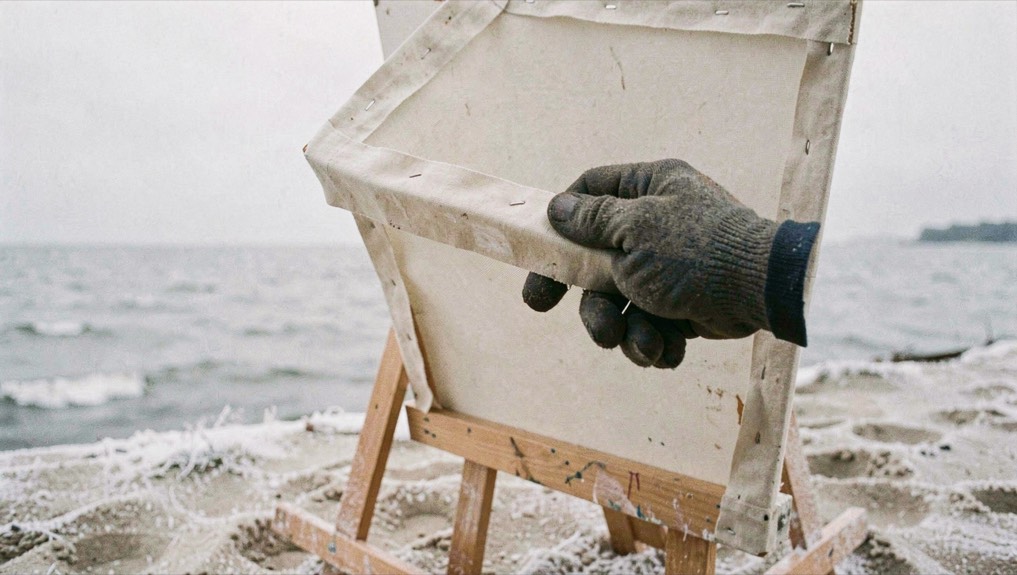
Winter is the season shoreline painters either avoid entirely or come to prefer. The light is lower, the days are short, the marsh has lost its colour, and the water reads as a single grey slab from the bank. Every one of those descriptions is a simplification, and the point of a cold session is to find out where each of them breaks down.
A mirror begins as flat glass, and what makes it a mirror is a thin reflective layer deposited on its back. Historically that layer was a tin and mercury amalgam; today it is almost always silver nitrate, sealed afterward with paint or a protective backing so the silver does not tarnish or lift at the edges. The making is a bench process, careful and repeatable, and the keeping is mostly about moisture and handling: wipe with a soft cloth, avoid ammonia on older glass, and let the backing stay intact. A page from the same desk, and kept, follows the sequence from coating to care.
This page sets out what actually changes when the bay turns pewter: what the light is doing, how a grey palette is read rather than mixed, what layering does to the work itself, and why a session that lasts forty minutes can be worth more than a comfortable morning in June.
What winter light actually does
The sun stays lower through the whole day, so the raking angle that a summer painter waits for at either end of the day is available for most of a winter afternoon. That is the gain. The loss is total light: less of it arrives, and much less bounces, because the marsh grass that reflected warm light in September has gone flat and pale and the leaves that filtered it are down.
Before digital tools took over, animation and comics were built at a desk with paper, ink, and a steady hand. Osamu Tezuka worked out a page rhythm that pulled a reader across panels, while Katsuhiro Otomo pushed line and architecture until a single frame could carry weight. These were drawing habits, not shortcuts, and they reward the same patience a small studio still keeps: lay the sheet flat, plan the sequence, commit the line. A page from the same desk, classic anime and manga drawing, traces how those three authors set the terms for the form.
Two other changes matter at the easel. Contrast between sky and water narrows, so the classic device of a dark water plane under a light sky stops carrying the picture. And overcast is more common, which removes cast shadow as a compositional tool and leaves form shadow, edge and value interval to do all the work. Painters who complain that winter scenes look empty are usually missing cast shadow rather than colour.
Reading a gray palette
The useful shift is from mixing greys to reading them. A winter bay is not one grey; it is a narrow band of them, and the whole picture depends on placing three or four correctly inside a range that may be less than two values wide. Painters working these conditions tend to fix the extremes first, the lightest light and the darkest dark actually present in the scene, and then place everything else between them by comparison rather than by recipe.
For a printmaker, the wall and the plate ask different things of the hand. Fresco is painted onto wet lime plaster, and the pigment sets as the plaster cures, so the image becomes part of the wall rather than a layer sitting on it. That distinction matters at the bench: a panel accepts revision, a curing ground does not. Knowing where a mark will live changes how much pressure you use and when you stop. A page from the same desk, and panel, works through those notes for printmakers weighing surface against structure.
The most common correction is temperature, not value. A grey that is right in value and wrong in temperature will look dead, and the fix is usually a small swing rather than a new mixture. This is where a short palette earns its place, because the swing has to be available in one move.
| Condition | Effect on the work | Adaptation |
|---|---|---|
| Low sun through the day | Raking light available for hours, not minutes | Choose a subject that depends on angle, not on brightness |
| Flat overcast | No cast shadow, narrow value range | Build the picture on edge and interval, keep the range honest |
| Cold hands | Loss of fine control after twenty to thirty minutes | Larger brushes, fewer decisions, planned early stop |
| Wind off the water | Easel movement, paint skinning, panel chatter | Low easel, weighted stand, smaller panel, back to the wind |
Layering for cold fingers
Clothing changes the painting, which is not obvious until it happens. Thick gloves cost fine control, so the work gets broader whether or not the painter intends it. Most solve this by splitting the difference: a warm layer that comes off for the drawing, thin liners for the painting itself, and a stop before the hands go rather than after. Wind protection matters more than insulation, because a steady breeze off open water removes heat faster than still cold air at the same temperature.
Materials shift too. Oil paint stiffens as it cools, and a palette that ran freely in September needs more physical pressure in January, which again pushes the work toward larger brushes and fewer, firmer marks. None of this is a handicap. It is a set of constraints that happens to suit the subject.
A temple roof is laid in overlapping courses from the eave upward, each tile hung or bedded so water sheds outward and never sits. That single rule explains most of what a repair crew looks for: lifted laps, cracked pans, clay that has gone soft where a valley holds moisture. Reading a roof means following the water's intended path before touching a tile. A page from the same desk, tile and clay, sets out laying, repairing and reading in plain terms, useful to anyone who keeps a small shop and a short ladder.
Sessions that end early
A winter session usually ends because the painter has run out of hands, not because the light has gone. That is a useful discipline: it forces the decision about what the picture is for into the first ten minutes. Many painters who work through the cold months keep the panel small, aim for a complete statement of the largest shapes, and treat detail as something that either arrives inside the window or does not belong.
The session notes matter more here than in summer, because the conditions are harder to remember accurately. The stage of tide, the wind direction and the actual air temperature belong in the book, next to the panel number, in the way described in a page a day. The reading of moving water that underlies every session on this shore is set out in reading tide light.
Measure the wall before you cut anything. A shelf that fits the space it will occupy causes less trouble later than one bought on impulse. Note where the studs fall, where the light comes in, and how far a chair back needs to travel. Then list what will actually sit on the boards: jars, clamps, a stack of paper, the odd box of screws. Depth follows the tallest item, not the widest. A page from the same desk, small room, works through that order plainly, and the habit carries to any bench.
Frequent mistakes to avoid
- Expecting summer contrast. A winter bay often holds less than two values between water and sky, and forcing more turns the scene into an invention.
- Mixing greys from a formula. The grey has to be placed against the two extremes actually present, or it will be right on the palette and wrong on the panel.
- Dressing for temperature instead of for wind. Heat loss on an exposed point is driven by the breeze off the water.
- Working until the hands fail. Control goes before the painter notices, and the last ten minutes usually damage the first thirty.
The dark half of the year is also when the shore makes its own light rather than painting it, and the practice of cutting and lighting a gourd for the turn of the year is set out in carving the turn of the year.
The cold months also strip the shoreline back to its structure, which is when the material left by the tide is easiest to see and sort. That inventory is kept separately in what the tide leaves.