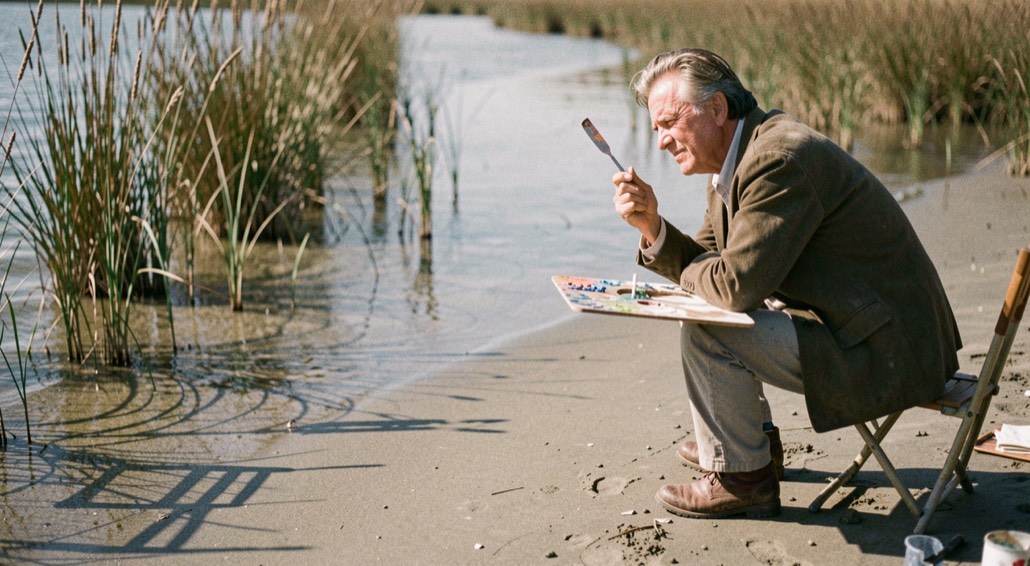
A painter working inland fights one clock. The sun moves, the shadows swing, and a session that began with a long raking shadow ends with the same field lit flat. On a tidal shore there is a second clock, and it does not keep the same time as the first. The water rises and falls roughly twice a day, and what it covers and uncovers changes both the shape of the subject and the amount of light thrown back into it.
Distance changes what you can check, so treat the seller's description as a set of claims rather than a promise. Ask for the title page, since it carries the book's identity: publisher, printing, and any marks of ownership. Then think about packing, because a volume that travels poorly arrives as loose signatures and torn hinges. A page from the same desk, a secondhand book, lays out these three habits in order, and they hold whether the parcel crosses a county or an ocean. Read the listing twice before you pay.
This page follows one ordinary session on a Chesapeake flat and sets out what has to be decided before the first mark, what can still be changed halfway through, and what is better abandoned than repaired. It is a description of working practice, not a method to be copied stroke for stroke.
Why tide light is a different problem
Moving shadows are predictable. A tide changes the reflector. At low water a broad flat of wet sand and mud is exposed, and a wet surface returns far more light upward than the dry sand beside it: the ground under the subject becomes a second, weaker light source, filling shadows from below and lifting the underside of everything standing on it, from a hull to a heron. As the water returns, that flat is replaced by a surface that reflects the sky at a low angle instead, so the fill light does not simply weaken, it changes colour and direction.
The consequence for a session is practical. Values set in the first twenty minutes may still be right an hour later, or the whole shadow family may have shifted by half a step while the sky overhead did nothing at all. Painters who work these flats regularly tend to fix the shadow value early, deliberately, and then defend it, rather than adjusting to what the ground is doing at any given moment.
A small notebook changes how a poem behaves. A haiku is drafted in one sitting and finished over months, which means the page has to hold both the first impulse and the slow correction that follows. The method is simple: date each draft, keep the earlier versions visible, and let revision happen in the margins rather than on fresh paper. The practice sits well beside sketchbook discipline; both depend on returning to the same sheet with a cooler eye. Readers who want the full working method can follow the notes on keeping a haiku notebook, where drafting, dating, and revising are laid out step by step.
Choosing the session window
The window is chosen before leaving the house, from two independent readings. The first is the tide: NOAA Tides and Currents publishes predicted times and heights of high and low water for stations along the Maryland shoreline, alongside observed water levels (consulted 5 September 2026). The second is the wind, because the predictions are astronomical and a sustained blow can hold water on a flat, or push it off, well away from the printed time. A local forecast, such as the one issued by the National Weather Service office at Baltimore and Washington, is the companion reading.
Most shoreline painters plan against the turn rather than against a clock hour. A session started an hour after high water gives falling ground, an expanding flat and a subject that grows more complicated as it goes. A session started an hour after low water gives the reverse: a simplifying subject, water creeping back over the detail, and a natural end point. Neither is better. They ask for different paintings, and the choice is worth making on purpose.
What the palette gives up and keeps
Field palettes on this shore are short, and they are short for a reason that has nothing to do with purism. A long palette invites mixing time, and mixing time is exactly what a moving subject does not grant. What is kept is the ability to swing the temperature of a grey quickly, because that is the one move the tide keeps demanding. What is given up is the range of high chroma that a studio palette carries for a handful of accents.
Weather decides more of a small outdoor ceremony than any other single factor, so the work starts with three forecasts rather than one: the weather you expect, the weather you can tolerate, and the weather that ends the outdoors part of the day. Write all three down before the date is fixed. Light follows the same logic. An afternoon start gives softer shadows and a longer window to move indoors if the third forecast arrives early. A page from the same desk, small outdoor ceremony, treats the plan B as part of the planning, not as a failure of it.
| Stage of tide | What the light does | Palette decision |
|---|---|---|
| Low water, flat exposed | Strong upward fill from wet ground, shadows open and warm | Keep shadow mixtures light and warm, hold the darkest dark in reserve |
| First of the flood | Fill weakens as sheets of water spread, edges of the flat soften | Cool the shadow family by one step, stop adding new detail |
| Half tide, water moving | Broken sky reflection, value of the water rises toward the sky value | Set water and sky closer together, reserve chroma for the bank |
| High water, wind ripple | Mirror reflection breaks up, general contrast drops | Simplify, resolve the largest shapes, treat the session as ending |
Working habits that survive the change
Three habits recur among painters who finish work on these flats. The first is to state the shadow mass before anything else and to write the time next to the panel, so that a decision made under one condition is not silently revised under another. The second is a panel small enough to be resolved inside the window that was chosen, which for many painters means something that fits in one hand. The third is to stop when the subject stops, rather than to keep working on a scene that has already been replaced by water.
The notes that make the next session faster are not made on the panel. They go in the book: time, stage of tide, wind, what the ground was doing, what the mixture that worked was made of. That is the same working record described in a page a day, and it is what turns a good accident into a repeatable decision.
Frequent mistakes to avoid
- Treating the printed tide time as the observed one. Wind and air pressure move real water levels away from the prediction, and the flat is either there or it is not.
- Chasing the shadow. Once the fill light from the exposed ground begins to fail, repainting the shadows to match wastes the only part of the panel that was already resolved.
- Starting a large panel at the turn. The subject that justified the size will be gone before the surface is covered.
- Bringing the studio palette. Extra tubes buy chroma that the scene will not use and cost mixing time the tide will not give back.
A session read this way tends to produce fewer finished panels and more usable ones. The material that is uncovered while the water is away is itself worth attention, and it is inventoried separately in what the tide leaves. The colder half of the year changes every reading above, and it is treated on its own page.
Tulip borders are decided in autumn, not in April. Sort the cultivars you already have into early, mid, and late windows, then set each group at the depth and spacing it asks for, since a shallow bulb and a deep one do not wake on the same week. The work is quiet and mostly clerical: labels, a planting plan, a note on where the light falls first. A page from the same desk, planning tulips a season ahead, treats the border as a calendar rather than a single spring event, which is how a small garden keeps color running instead of spending it all at once.
What the tide decides for the ground, the air decides for the paper. A wash laid on a humid morning stays open longer and is read differently from the same wash on a windy afternoon, and the sequence is kept in the flat wash sequence.
Sources consulted for this page on 5 September 2026: NOAA Tides and Currents, tidesandcurrents.noaa.gov, for tide predictions and observed water levels; National Weather Service, Baltimore and Washington forecast office, weather.gov/lwx, for local wind forecasts.