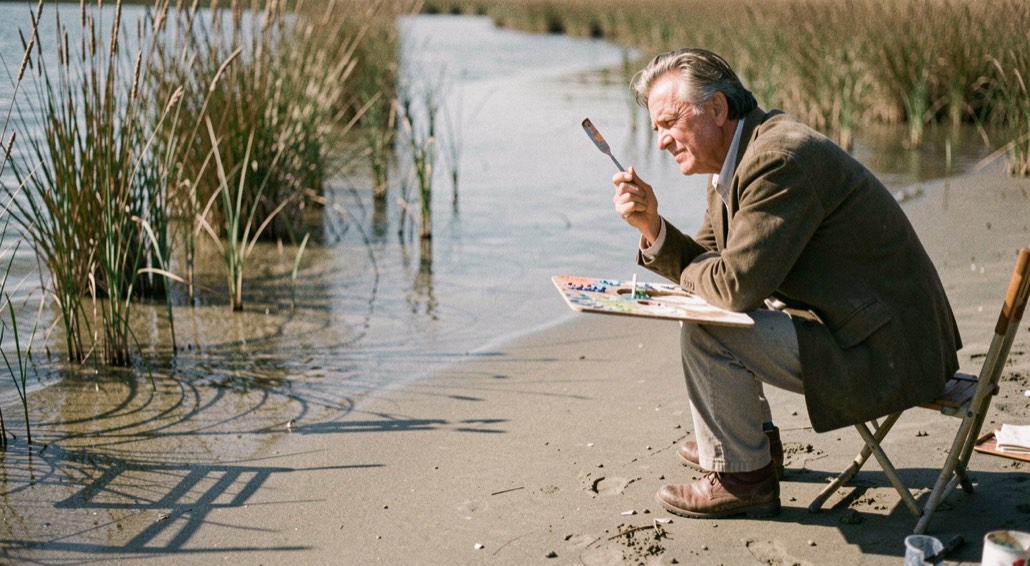
A flat wash is laid in one pass and then left alone. The brush is loaded once, kept moving at a steady speed, and never returns to a passage that has begun to dry. A graded wash is the same pass with less pigment, or with clear water, worked into the mix as the stroke travels down the sheet. Streaks are rarely a fault of the brush. They come from re-entering a half-dry wash, from a mix too small for the area being covered, or from a board tilted so far that the bead at the bottom skins over before it can be drawn off.
Before digital tools, the page came first. A single sheet held the whole problem: where the eye lands, how long it lingers, when it moves. Osamu Tezuka built a page rhythm that carried a reader across panels, and the habit shows in any sketchbook kept at a bench. Katsuhiro Otomo pushed line and architecture until a street felt weighted and real. These are drawing decisions, not software settings, and they reward the same slow attention a working shore asks for. A page from the same desk, How Classic Anime and Manga were drawn, traces those terms plainly.
The fuller treatment of that sequence, with the water-to-pigment ratio and the timing behind each pass, is kept by how to lay a watercolor wash, a magazine that works through watercolor technique, paper, brushes and pigments for painters reading the natural world. What follows here is the same sequence as it behaves outdoors on this shore, where the air is wetter than a studio and the wind decides how long a wash stays open.
How do I lay a flat or graded watercolor wash without streaks?
Everything that prevents streaking is decided before the brush is wet. The paper is stretched or taped flat on a board, because a sheet that cockles between strokes makes the wash pool in the hollows. The board is tilted by ten or fifteen degrees, just enough for gravity to carry the bead down without dragging pigment faster than the brush. The mix is made in a puddle three times the size of the area to be covered, so that the brush never has to be reloaded against a drying edge. And the brush is the largest soft brush at hand, because a large brush covers ground in fewer strokes, and every stroke added to a drying wash is a streak waiting to happen.
The stroke itself is a single journey. Starting at the top of the area, the brush travels across and down, and the bead of wet paint at the bottom of each band is picked up by the band below it. If the bead is kept moving, the wash dries as one surface. If the brush is reloaded carelessly mid-pass, the fresher, wetter paint lifts pigment from the band above and leaves a tide mark that no amount of later work removes cleanly.
A graded wash changes one variable at a time. Either the mix is diluted progressively as the brush travels, or the board is tilted a little more so that the pigment settles thicker at the bottom edge, or a second, weaker puddle is introduced where the wash is meant to open out. Two-colour gradations are made the same way, with the second colour brought in while the first is still flowing, and with one pass only at the meeting line. Blending a gradation twice is the quickest route to a grey the painter did not intend.
Working small on purpose is a way to make decisions visible. A pixel is a decision you cannot hide behind: the grid is fixed, the palette is finite, and every placement shows. The same holds at the bench. A thumbnail sketch, a test strip, a short length of line, each one forces the question of what actually matters before the larger work begins. Constraint is not a limit here so much as a way of seeing. A page from the same desk, small on purpose, sets out pixel art lessons along those lines, and they read plainly to anyone who works with their hands.
Paper decides how much time is available. A cotton sheet holds water in its fibres and stays workable for minutes; a sheet made from wood pulp gives its water up quickly, and a hesitation of a few seconds becomes a hard line. The difference is worth knowing before a session is planned, because it sets the size of the area a painter can cover in one pass.
What is glazing in watercolor and how do I build depth in layers?
A glaze is a transparent layer of paint laid over a dry layer. Light travels through both, reaches the paper, and returns through them again, which is why watercolor depth comes from the number of transparent layers rather than from opaque coverage. There is no white to add: the paper is the light, and every glaze subtracts from it.
Three rules govern the practice. The layer underneath has to be dry rather than damp, or the new stroke lifts it and leaves a bloom. The glaze is applied with a wetter, weaker mix than the layer below and with a light touch, so that no pigment is scrubbed into the paper. And the order runs from light to dark, because a dark glaze over a light passage is straightforward while the reverse is not.
Depth is built by counting. Three to five glazes resolve most passages, and each one shifts the hue as well as the value, since two transparent layers of different pigments never combine exactly the way the same two pigments mixed on the palette would. A short palette helps here: with six or seven pigments the painter can predict what the fourth layer will do, and a warm over a cool is a reliable way to settle a passage that has gone too bright. Granulating pigments, the ones that settle into the texture of the sheet, add surface as well as colour, which suits stone, water and weathered wood.
More layers are not automatically richer. Past the point where the tooth of the paper is filled, the surface flattens and light stops travelling through it, which is the dull look painters describe as dead. A pause between glazes is part of the method rather than an interruption of it.
Reading a tiled roof begins at the eave, where the first course sets the pattern for everything above it. Each tile is hung or bedded so water sheds outward and never sits, and the overlaps run upward in courses that a patient eye can trace from the ground. Repair work follows the same logic in reverse: lift a broken tile, note how its neighbors carry it, and replace without disturbing the shedding line. For a fuller account of tile and clay, including laying, repair, and how to read a temple roof course by course, the notes gathered at that desk cover the subject plainly and in order.
Why does my watercolor turn muddy, and how do I fix hard edges and blooms?
Mud has three ordinary causes, and they are worth separating. The first is mixing too many pigments while they are still wet, particularly two colours that sit opposite each other on the wheel, which cancel into a neutral brown-grey. The second is overworking a passage, which lifts pigment from the paper and stirs it back into the wash. The third is glazing over a layer that was still damp, which is mud and bloom arriving together.
Each has a different repair. A passage that is still wet can be lifted with a clean, damp brush and blotted once, then left alone; the paper will hold less pigment there than around it, which is an effect that can be used. A passage that has dried can be settled with a single transparent glaze of one pigment, warm or cool, laid evenly over the whole shape, because the eye reads the corrected colour and forgives the loss of glow. What cannot be repaired is a passage that keeps being adjusted. Watercolor punishes attention.
A hard edge is a boundary where a wash stopped and dried. Some are wanted: a roofline, a hull, a marsh bank read as a shape. The unwanted ones arrive when a wash dries before it can be moved, and they are softened while the paper is still damp, by drawing a clean, barely wet brush along the boundary once, in one direction. Scrubbing back and forth makes it worse, because it roughens the paper and leaves a lighter scar.
A bloom, sometimes called a backrun, appears when water lands in a passage that is already beginning to dry: the water pushes pigment outward and leaves a pale, irregular centre with a hard rim. Blooms are avoided by leaving a drying wash alone, by keeping the weather off a wet panel, and by not carrying a wet board at an angle. They are also useful, since a bloom over wet stone or cloud reads as texture rather than as an accident.
Packing a meal to carry across town or down to the dock asks for the same care a bench asks of any job: shallow, lidded containers so nothing shifts, a frozen block under the cold items to hold them below 40 F, and wet kept apart from crisp until the plates go down. A table that travels is built in the packing, not at the arrival. Set the lid square, label what needs to stay cold, and the shared meal opens the way it was meant to.
What the shore does to a wash
Outdoors, the variables a studio keeps constant are all moving. Humidity is higher near the water, which slows drying and keeps a wash open longer than the clock suggests. Wind removes that advantage in a single gust, drying the top of the board while the bottom is still wet, so that the wash dries from the wrong end. Sun on a dark board turns the panel into a griddle and can dry a wash from underneath, and salt air leaves a fine film on the sheet that a sponge at the end of the session takes off.
The habits that answer this are the ones the rest of the session already uses. A mix is made larger than the passage needs. The board is kept flat once the wash is laid, because a wet sheet carried at an angle pools its water and blooms at the low corner. A spare sheet stays in the folder, since a wash that has to be abandoned is not a failure when the alternative is fighting the paper for an hour.
| Condition | What it does to the wash | Response on the board |
|---|---|---|
| Wet air over the water | Slows drying, keeps the bead workable for minutes | Work a larger area in one pass, keep the board tilted |
| Wind across the flat | Dries the top edge first, pulls the wash out of shape | Turn the board, cover the passage, reduce the area |
| Sun on a dark board | Dries from underneath, lifts pigment in pale patches | Work in shade, use a light board, wet the sheet evenly first |
| Cold with a low sun | Very slow drying, glazes can be laid sooner than expected | Keep the layers thin and count them |
Frequent mistakes to avoid
- Reloading against a drying edge. The fresher, wetter paint lifts the band above and leaves a streak exactly where the brush stopped.
- Mixing a second puddle into a gradation that is already flowing. One pass decides a gradation; the second pass muddies it.
- Glazing onto a damp layer. The lower wash lifts, the two pigments blend on the paper, and the result is mud with a hard rim.
- Keeping a wet board at an angle. Water runs to the low corner and blooms in the one place the painter cannot hide.
A wash is a decision about time rather than a display of control, and the session that reads the air before the first stroke needs fewer repairs. The colder half of the year changes every number in the table above, and it is treated on its own page in winter light on the bay. The sheets left to dry while the light goes belong to the same end of the season as the lantern cut when the field year closes, in the October lantern.
Source consulted for this page on 14 September 2026: Tate, Watercolour, art term page on the medium, its pigments and its transparency, tate.org.uk.