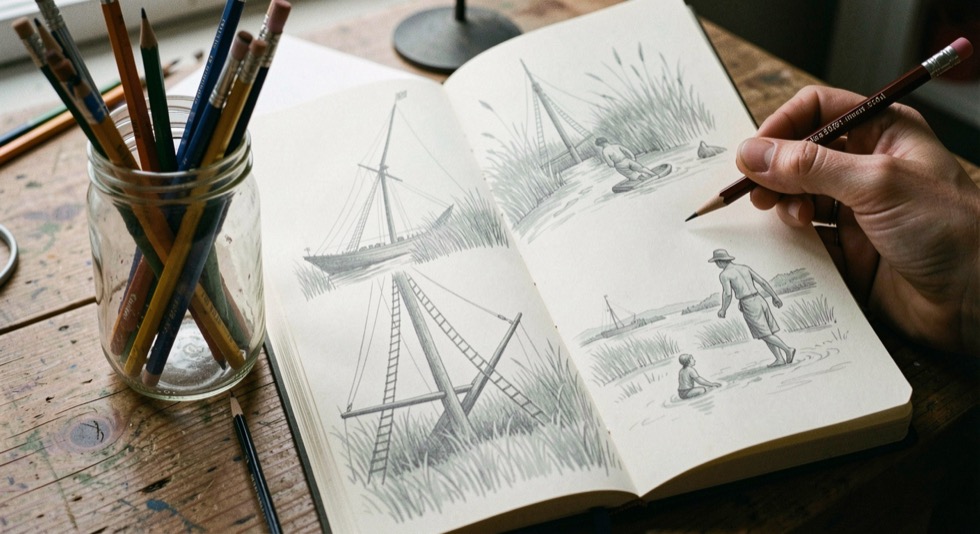
The sketchbook is the least ceremonious object in a studio and the one that does the most work. Nothing in it is meant to be shown, which is exactly why it stays honest: a page made for an audience becomes a small performance, and a performance cannot be used as evidence six months later.
Mirror work is quiet bench work, and it rewards a patient hand. The process itself is straightforward: a mirror is made by depositing a thin reflective layer onto the back of a sheet of flat glass, silver nitrate in most modern shops where a tin and mercury amalgam once served, then sealing the deposit with paint or a protective backing so the surface keeps its light. Keeping a mirror is the other half of the craft. The backing, not the glass, usually fails first, so a sound seal matters more than a flawless face. A cleaned edge and a dry storage shelf do most of the preserving.
This page treats the sketchbook as a working record rather than a display piece. What actually goes on a page. How the margin is organised so that a year of field notes can be searched. How pages turn into finished work without being copied. And how a daily habit survives once the novelty has worn off.
What the page holds
A working page usually holds three things at once, and separating them is most of the skill. There is the drawing, which records a shape, a value relationship or a movement. There are the words, which record what the drawing cannot: the colour that is not on the page, the smell of the mud, the fact that the boat swung before the line was finished. And there are the conditions, which turn the page from a memory into data.
A farmhouse room rented for a weekend is a working space before it is a pretty one. The couple should ask the barn venue four plain questions: where the power runs and how much load it carries, what lighting is fixed and what must be brought in, when the trucks may pull up for load-in, and who resets the room once guests leave. Write the answers down before any linen or flowers are chosen. A page from the same desk, Dressing a Farmhouse Room for a weekend, treats those four points as the first checklist, and the rest of the dressing follows from them.
The conditions are the part beginners leave out and working artists never do. Date, time, place, weather, stage of tide, direction of the wind, direction of the light. None of it is decorative. A drawing of a flat at low water with no time written next to it is a picture; the same drawing with the time and the tide state is a reading that can be compared with the next one.
Margin systems for tide work
The margin is the index. On a tidal shore the useful margin carries the same short set of entries in the same place on every page, because that is what makes a book searchable by flicking rather than by reading. Most systems come down to a narrow column on the outer edge holding date, time, place code, tide state and weather, with everything else left to the body of the page.
A printmaker at the bench works in layers, and so does a wall painter. One page from the same desk, fresco and panel, sets the difference plainly: fresco is painted onto wet lime plaster, and the pigment sets as the plaster cures, so the image becomes part of the wall rather than a layer sitting on it. For anyone who pulls proofs and registers plates, that distinction is worth keeping in mind. A panel accepts what you place on top of it. A wall takes the color into itself, and the drying is the fixing.
The tide state is worth writing as a relation rather than as a number: two hours after high water is more useful at the easel than a height in feet, because it says what the ground is doing. The predicted times themselves come from NOAA Tides and Currents, which publishes tide predictions and observed water levels for stations along the Maryland shoreline (consulted 5 September 2026); the observed level is worth a glance afterwards, because wind can hold water on a flat well past the printed time.
| Margin entry | Written as | What it is for later |
|---|---|---|
| Date and time | Day, then start and stop of the session | Fixes the light angle and the length of the working window |
| Place | A short repeated code, not a description | Groups every page made at the same spot across years |
| Tide | Hours before or after high or low water | Says what the ground and the reflected light were doing |
| Weather | Sky, wind direction, rough temperature | Explains contrast, colour and how long the hands lasted |
| Follow up | One mark for pages worth returning to | Turns a year of pages into a short shortlist |
From page to studio
Pages feed studio work best when they are not copied. A drawing made in twenty minutes on a cold bank carries a decision, usually about shape or value, and that decision is what travels. Copying the page instead reproduces its accidents at a larger size, which is why enlarged sketches so often look weaker than the sketch.
The practical method most working artists describe is to read several pages together rather than one. Three pages of the same place at different tide states show what is constant and what was circumstantial, and the constant part is what a painting can be built on. In a ceramics studio the same pages feed form rather than image, and the record they resemble most is the one described in keeping a kiln log: a fixed format, filled in at the time, readable side by side.
A small stream rewards the angler who arrives without hurry. Read the water before stepping in: the seam beside a rock, the dark run under an overhanging branch, the shallow riffle that hides nothing. Carry only what you will use, a short rod, a few flies, a net that clips to the vest. Cross at the wide, gravelly places and exit the way you came, so the bank stays as you found it. A page from the same desk, Small Stream Fishing on Foot, sets out those three habits plainly: reading water, packing light, and leaving the bank intact.
Keeping the streak honest
A daily habit fails in one of two ways. It stops, or it becomes a performance in which the page is filled to satisfy the streak rather than to record anything. The second failure is worse, because it leaves a book that looks full and teaches nothing.
The habits that hold are modest. A small book, because a large one demands a large page. A short minimum, such as one honest observation, so that a bad day still produces a real entry. And permission to write instead of draw when the weather makes drawing pointless, because a written note with the conditions attached is worth more than a bad drawing without them. What matters is that the book is never edited afterwards: a record that gets tidied is no longer evidence.
A small room holds more when the wall is measured before the shelf is cut. Start with the wall, then list the things that will sit on it: books, tool tins, a few boxes for the small parts that always gather at a bench. One page from the same desk, on shelves and boxes that hold a small room, walks through this order of work, wall first, contents second, and it matches how the shore workshop plans its own storage. The lesson is plain: measure twice, once for the room and once for what the room must carry.
Frequent mistakes to avoid
- Leaving out the conditions. A drawing without time, place and tide state cannot be compared with anything, which is most of its value gone.
- Keeping a book for show. As soon as pages are made to be seen, the difficult observations stop being made.
- Enlarging a sketch instead of using it. The decision in the page is what transfers; the accidents do not.
- Filling a page to protect a streak. A single honest line beats a page made to avoid breaking a run.
The sessions these pages come from are described in reading tide light, and the material that turns up in the margins, the shell, the wrack and the driftwood, is inventoried in what the tide leaves.
Source consulted for this page on 5 September 2026: NOAA Tides and Currents, tidesandcurrents.noaa.gov, for tide predictions and observed water levels.