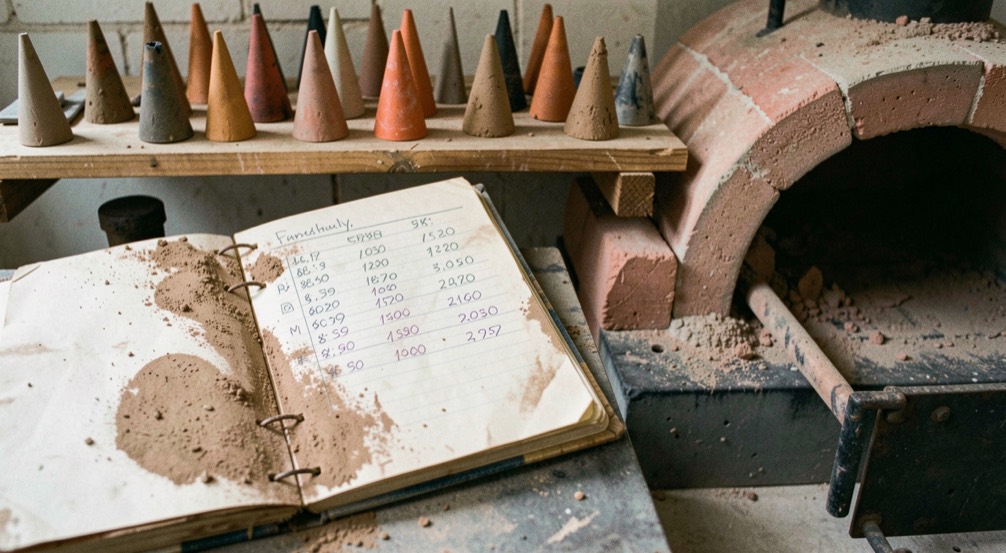
Every studio owns the same two records without always noticing it. One is the shelf of finished pots, which shows what happened and hides why. The other is the log, which is usually a cheap notebook with a wire spine, and which is the only document in the building that can be read backwards from a result to a cause.
Buying a secondhand book at a distance rewards patience more than luck. The habit that holds up is simple: read the seller's description as a set of claims to verify, not as a promise. The title page works as the book's identity card, telling edition, printer and date in a few lines, and it repays a slow look before any money changes hands. The last step is packing, because a volume that travels badly arrives worse. Notes on buying a book at a distance gather these habits in one place, kept the way a workshop keeps its edge tools, close at hand and ready before the work begins.
This page sets out what belongs in that record, how it is read after a firing rather than during one, and where the useful information actually comes from. Most of what a kiln gets blamed for was decided before the door closed.
What a kiln log records
A log that teaches holds four kinds of entry, and the studios that keep one usefully tend to separate them on the page rather than write a paragraph. There is the load: what went in, on which shelf, at what height, with which glaze, and how tightly it was packed. There is the schedule: the times at which the kiln was turned up, the readings taken from the controller or the pyrometer, and any hold near the top. There is the evidence: where the witness cones stood and how far each one bent. And there is the outcome: what came out, in plain words, including the pieces that were wrong.
The entry that gets skipped most often is the load map, and it is the one that pays. Without it, a glaze that came out short in one corner of the kiln is a mystery about the glaze. With it, the same result is a question about that corner, which is a far easier question to answer.
Reading a room's light begins with the task, not the fixture. A desk where you draw wants even, shadowless light from above and slightly forward; a chair where you read wants a warm pool at shoulder height, angled so the page stays bright and the glare stays off the paper. Note where the daylight falls through the day, then match the bulb to that pattern rather than to the shape of the lamp. A short page from the same desk, a room's light, walks through choosing a bulb for a room you read in, and it keeps the question practical: what the eye needs, and when.
Reading a firing after the fact
A cone is not a thermometer. It is a small pyrometric standard that bends when it has absorbed enough heat work, which is the combined effect of temperature and the time spent near it. The same cone therefore bends at a different indicated temperature depending on how fast the kiln climbed. The Edward Orton Jr. Ceramic Foundation publishes the cone equivalents as a chart organised in heating rate columns, and its own guidance is to select the column closest to the rate actually used before reading a value off it (consulted 5 September 2026).
That single fact changes how a log is read. A firing that reached the same peak reading as the last one but climbed more slowly through the final stretch did more heat work, and the cones will say so even though the controller does not. When a studio writes down the climb as well as the peak, a puzzling result usually resolves itself on the page rather than in an argument about the kiln.
The wedge table upstream
Half the entries in a mature log are not about the kiln at all. They are about what happened at the wedge table and on the drying shelf, because a firing can only reveal what was already in the piece. Air trapped during wedging, uneven wall thickness, a foot ring dried faster than the rim, a piece put in a fraction damp: each of these produces a failure the kiln gets blamed for.
A small outdoor ceremony rarely fails for lack of planning. It fails because the plan assumed one kind of weather. Set three instead: the weather you expect, the weather you can tolerate, and the weather that ends the outdoor part of the day. The third one is the useful one, since it tells you when to move inside without debate. Light matters as much as rain. Check where the sun sits at the hour you have chosen, and whether the shade will hold. A page from the same desk, a small outdoor ceremony, works through this with weather, light, and a plan B.
Studios that log the upstream work write down the clay batch, how long the pieces sat before the bisque, where they sat, and what the weather was doing. On this shore that last column earns its space, because a humid week changes drying times enough to matter and nobody remembers, in November, what the third week of August was like.
| Column | Written at the time | Question it answers afterwards |
|---|---|---|
| Load map | Shelf, height, position of each piece | Is the fault in the glaze or in that part of the kiln |
| Climb | Times and readings, holds near the top | Did this firing do more or less heat work than the last |
| Cones | Which cones were set, how far each bent | What the ware actually experienced, not what the meter said |
| Upstream | Clay batch, drying days, weather | Was the piece ready to be fired at all |
| Outcome | Plain description, including failures | Is this repeatable, and what would be changed |
When a log changes a schedule
The point of the record is to make a change that can be defended. A studio that has three firings written down in the same format can compare them; a studio that has three firings in memory can only compare impressions. The changes that come out of a log tend to be small and specific: a hold added near the top because the cones on the bottom shelf were consistently behind, a shelf left out because the pack was too tight for even circulation, a batch of pieces given two extra days on the shelf because the log shows that the ones fired damp are the ones that cracked.
None of that requires special equipment. It requires the same page format every time, so that two firings can be laid side by side. The discipline is identical to the one described in a page a day, and it is close kin to the proof notes kept beside a press in proofing by hand.
A deck log is not read like prose. It is read in columns: date and time at the left, position and course through the middle, remarks at the right, with the officer of the deck signing at the close of each watch. Muster rolls work the same way, names and stations set in a grid that rewards a slow eye. The habit carries over to any page from a ship's record, where the shape of the entry tells you what mattered that day. A short piece on reading a ship's record, deck logs and muster rolls, lays out that column logic for anyone who wants to try it at their own desk.
Frequent mistakes to avoid
- Recording the peak reading and nothing else. Without the climb, the cones and the meter will disagree and there will be no way to tell which is right.
- Leaving out the load map. A position problem then looks like a glaze problem for as long as the studio keeps mixing new glaze.
- Writing only the firings that worked. The failures carry most of the information, and a log without them is a scrapbook.
- Changing two things at once between firings. The next log entry will show a difference and will not show which change caused it.
A log kept this way is dull to write and quietly valuable to own. It is also the studio record that most resembles the field notebooks used along the shore, where the same principle applies: the note made at the time is worth more than the memory of it. What the water brings up to those benches is inventoried in what the tide leaves.
Source consulted for this page on 5 September 2026: Edward Orton Jr. Ceramic Foundation, pyrometric cone temperature equivalents, ortonceramic.com.