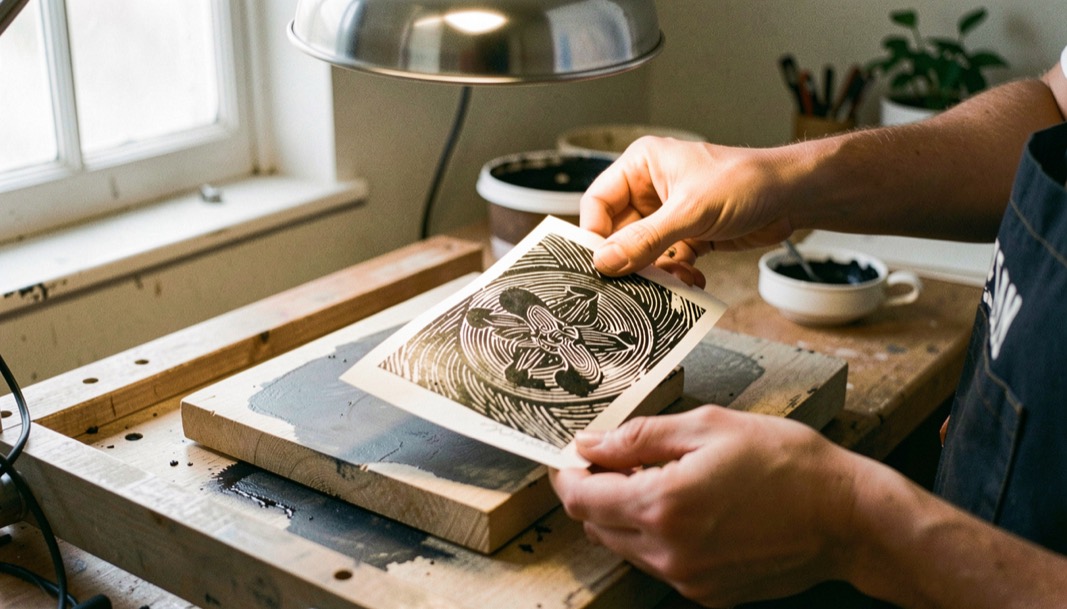
A first proof is not a print. It is a diagnosis. It exists to show the printmaker what the block, the ink, the packing and the paper are currently doing together, and almost everything that happens afterwards is a response to what that sheet said.
A corsage holds best when the fixing suits the cloth rather than the occasion. On a firm, medium-weight weave, a magnet pair keeps the bloom in place and leaves the fibers as they were found. A lapel that can hide its own hole takes a pin, set once and set carefully. For anything that must not be pierced, a tied point at the stem does the work. The choice is small, but it decides whether the garment returns to the wardrobe unchanged. Notes on a corsage without damage to the fabric gather the three methods in one place, matched to weight and finish.
This page follows that routine on a small hand press: how the press is set before the first pull, what an impression is actually read for, how registration is held without commercial jigs, and what changes when a proof becomes an edition. The vocabulary is kept plain, because a press is better explained by what it does than by what it is called.
Setting the press for a first proof
Three things are set before any ink is rolled out, and all three are set low. The pressure comes first: enough to transfer, not enough to spread. Too much pressure pushes ink out beyond the cut edge, fills the fine lines and makes a block look coarser than it is, and the printmaker then corrects a carving problem that does not exist. The packing comes second, because it decides how evenly that pressure arrives across the bed. The ink film comes third, and it is easier to add a little than to clean a slab and start again.
Reading a room's light begins with the task, not the fixture. Before choosing a bulb, note what happens at the table: pages held flat, a hand casting a shadow across the line, a lamp too far behind the shoulder. The work tells you what the light must do. A bulb that flatters a wall may leave the page dim; a brighter one may glare off paper. Match the color and the spread to the reading, then adjust the fixture. A page from the same desk, rooms light, walks through that order of decisions for anyone sorting out a reading corner.
The ink is rolled out until it makes a particular sound under the roller, a fine hiss rather than a wet suck, and until it looks matte rather than glossy on the slab. That is not mysticism; it is a rough reading of film thickness that works because it is repeatable within one studio, on one slab, in one temperature.
Reading the impression
The proof is read in a fixed order, so that nothing is judged before its cause has been checked. Edges first: a cut line that has closed up means pressure or ink film, not carving. Then the flats: a solid area that is grey and mottled is short of ink or short of packing under that part of the bed. Then the corners, which show whether the pressure is even. Only after all of that is the image judged as an image.
Any working collection of records carries a second archive with it: the sleeves. These are printed by offset lithography onto coated board, usually a clay-coated stock of 300 to 400 gsm, heavy enough to hold a die-cut, scored and glued pocket without collapsing at the corners. The clay coating takes ink cleanly, which is why older sleeves still show crisp type decades after the press run. The安妮 arundel desk keeps notes on this paper a music collection leaves behind, from board weight to glue lines, in the same plain terms a bindery would use.
What separates a working printmaker from a frustrated one is usually the order of that list. A proof read out of order produces a return to the carving bench, and the same fault comes back on the next sheet because the press was never the suspect.
| What the sheet shows | Most likely cause | First adjustment |
|---|---|---|
| Fine lines closed or filled | Ink film too heavy, or pressure too high | Roll out thinner, drop pressure by one step, pull again |
| Solids grey and mottled | Ink film too thin, or packing too soft | Add ink in small passes before touching the packing |
| One corner consistently weak | Uneven packing or a bed that is not level | Shim the packing, re-pull, note the position in the book |
| Image shifting between sheets | Paper placed by eye rather than to a stop | Set a physical stop and register every sheet to it |
| Sheet cockling or refusing ink | Paper too damp or too dry for the day | Change the dampening time, and write down what worked |
Registration without jigs
Small presses hold registration with geometry, not with hardware. The usual arrangement is a base sheet marked with the position of the block and the position of the paper, so that every sheet arrives at the same place because it is pushed against the same two stops. Two edges are enough to fix a sheet; three is one too many and fights the paper.
The variable that defeats this on a humid shore is the paper itself. Paper takes up moisture from the air and expands, mostly across one direction, so a sheet that registered perfectly in a dry week can be measurably longer in a wet one. The practical answer is not to fight it but to keep the conditions consistent within a session: dampen the same way, wait the same time, print the whole run before the weather turns. The printmaker who writes those times down stops rediscovering them.
A deck log is read in columns, not as prose. Date and time sit on the left, position and course in the middle, remarks on the right, and the officer of the deck signs at the close of each watch. Muster rolls work the same way: names in order, dates of entry, and notes on duty or discharge. Read together, the two records let a researcher follow a vessel and her crew across a season without guessing at the gaps. A short guide to reading a ship's record, column by column, is kept here: reading a ship's record.
Editioning at a working pace
An edition is a promise that the last sheet resembles the first, and the enemy of that promise is drift. Ink stiffens on the slab as it sits. Pressure feels heavier as the arm tires. Paper dampened at the start of a session is drier by the end. Each of these moves the print a little, and none of them announce themselves.
Printers who hold an edition together tend to work in short runs with a reference sheet pinned in view, roll fresh ink at fixed intervals rather than when the print looks wrong, and stop before fatigue rather than after it. The record kept beside the press is the same instrument as the one described in keeping a kiln log: a fixed format, filled in at the time, that lets two sessions be compared instead of remembered.
A small room rewards patience before it rewards effort. The habit worth keeping is simple: measure the room before moving anything, then fix the order of work. Seating comes first, storage second, the kitchen last, because each choice narrows the ones that follow. Tape, pencil, a rough sketch on the back of an envelope, half an hour at the door before a single shelf shifts. We have written this out at full length elsewhere, and the measure first note holds the reasoning step by step. In a working room, the numbers come first and the lifting comes after.
Frequent mistakes to avoid
- Correcting the block first. Most first-proof faults are pressure, ink film or packing, and recutting removes material that cannot be put back.
- Adding ink to fix a weak solid without checking the packing. The result is a heavy film that closes the fine lines on the next pull.
- Registering by eye. Two physical stops cost nothing and remove the most common source of drift across an edition.
- Printing an edition across two days without noting the dampening times. The paper will not be the same paper on the second day.
Paper behaves the same way at an easel as it does under a press: it takes up water, swells across one direction and changes what the surface will hold. The painter's answer to that, a wash laid in one pass and left to dry untouched, is worked through in washes in humid air.
The edge that cuts the block belongs to another bench entirely, and it is kept sharp by the routine set out in sharpening at the bench. The subjects that end up cut into these blocks are, more often than not, gathered from the material listed in what the tide leaves.