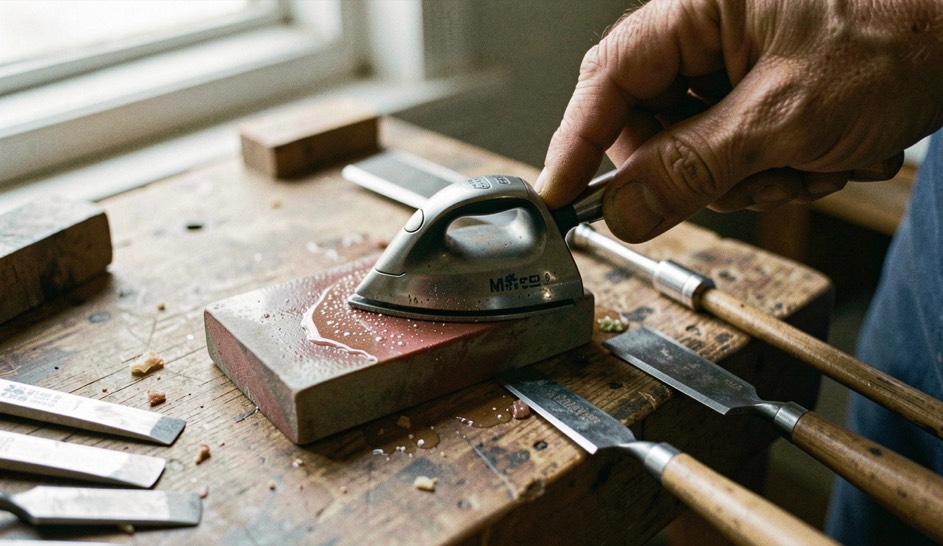
The half hour a woodworker spends at the stones is the least visible part of the day and the one that decides the rest of it. A dull iron does not simply cut slowly; it tears end grain, wanders in a cut it should follow, and makes the worker push, which is how mistakes and injuries both arrive.
A corsage is a small problem with a long history at the bench: how to hold a flower to cloth without leaving a mark. The answer depends on the weave. A firm, medium-weight fabric takes a magnet well, since the two halves meet through the fibers and leave no hole. A lapel that can hide its own hole takes a pin. Anything that must not be pierced, a silk or a fine knit, takes a tied point instead. The same desk has a page on fixing a corsage without damaging fabric, and it sets out those three cases plainly.
This page keeps to the bench itself: what edge the work actually needs, what the stones and strops are for, what salt air does to steel that inland workshops never have to think about, and what a sharpening rhythm looks like when it is a habit rather than an emergency.
The edge a bench needs
An edge is the meeting of two surfaces, and it is only as good as the flatter of the two. That is why the back of a chisel or plane iron is worked first and then, in principle, never again: once the back is flat and polished near the edge, every subsequent sharpening is a matter of restoring the bevel until the two polished surfaces meet.
A farmhouse room for a weekend asks for a plan before it asks for decoration. Ask the barn venue about power, lighting, and load-in windows first, then decide who resets the room before guests arrive. Those four answers shape everything else: where the extension cords run, how early the tables can be placed, and whether the last candles get blown out by staff or by you. Write the sequence down, keep it to one page, and hand a copy to whoever holds the keys. The rest is arranging, which is the pleasant part. A page from the same desk, a farmhouse room dressed for a weekend, covers the same ground.
The practical target is not a number. It is a burr that can be felt with a thumbnail along the whole width of the edge, followed by the removal of that burr. A worker who can feel the burr appear and knows what it means has the whole method; a worker who counts strokes without checking for it is guessing. Bevel angles are chosen by the job rather than by doctrine: a lower angle pares softwood cleanly and folds over in hardwood, a higher one lasts in hard timber and needs more push in soft.
Stones, strops and angles
Nothing in this staging is specific to a flat bevel. A turner grinds the same sequence onto a gouge, and the Vermont Woodturning Journal keeps bench notes on gouge geometry and sharpening workflow that treat the edge as a system of grind, bevel and presentation rather than a number on a gauge. The burr that decides the work here decides it there too.
Three stages do everything a bench requires. A coarse stage removes metal and re-establishes the bevel when the edge is chipped or badly rounded. A medium stage removes the scratches the coarse stage left. A fine stage polishes until the surface reflects. A leather strop with a fine compound then removes the last burr and leaves an edge that pares rather than scrapes.
A record sleeve is not a folder. It is a printed object with a structure: offset lithography lays the image onto coated board, usually a clay-coated stock of 300 to 400 gsm, and then the die cuts, scores and glues it into a pocket sized for the disc. The board has to hold a crease without cracking and stay flat on a shelf. Anyone who keeps records knows the paper outlasts the pressing run, and the notes printed on it often carry more than the label. A page from the same desk, The Paper a Music Collection leaves behind, follows that material from press sheet to pocket.
The single largest source of frustration is not the stone grade but the flatness of the stone. A hollow stone rounds the bevel it is meant to flatten, and the worker then blames the steel. Whatever the abrasive, the stone is flattened on a schedule, not when the problem becomes obvious. Holding a consistent angle matters more than choosing a fashionable one, which is why many benchworkers use a simple guide for the coarse work and free hand only the polishing.
| Stage | What it does | How the worker knows it is finished |
|---|---|---|
| Coarse | Removes metal, re-establishes a damaged bevel | A burr is felt along the whole width of the edge |
| Medium | Removes the coarse scratch pattern | The bevel carries one even pattern, no deep lines left |
| Fine | Polishes the bevel and the back near the edge | The bevel reflects, the burr is small and even |
| Strop | Removes the last burr, refines the meeting of the faces | The edge pares end grain without being forced |
| Stone flattening | Keeps the reference surface true | Done on a schedule, before the bevel goes round |
Salt air and tool steel
Two things happen to a bench near open water. Steel corrodes faster in humid, salt-laden air, and the wood on the bench moves more than it would inland. The second is measurable: the USDA Forest Products Laboratory records that average equilibrium moisture content is close to eleven percent along the Atlantic and Gulf coastal regions, against roughly eight percent for most of the United States, and that thoroughly air dried lumber in much of the country settles at twelve to fifteen percent (Wood Handbook, General Technical Report FPL-GTR-190, consulted 5 September 2026).
Fishing a small stream on foot rewards a slow approach more than any piece of tackle. Read the water before you step in: where the current narrows, where a rock breaks the surface, where the seam between fast and slow water holds a fish. Carry only what you will actually use, a short rod, a few flies, a net that clips to a vest. Cross and exit at points that leave the bank as you found it. A page from the same desk, stream fishing on foot, sets out those three habits in plain terms.
For sharpening, the consequence is about storage rather than technique. An edge that is polished and then left damp on the bench overnight is not a polished edge in the morning. The habits that answer this are unremarkable: wipe the tool dry before it is put away, keep a light film of oil or wax on the exposed steel, close the box or the cabinet, and do not leave water sitting on a bench under a rack of chisels. For the woodwork itself, the same coastal moisture figure is the reason panels are given room to move and stock is allowed to acclimatise in the shop before it is worked.
A sharpening rhythm that holds
Sharpening as an emergency is slow, because an edge is only ever addressed once it is bad enough to notice, which means starting again from the coarse stone. Sharpening as a rhythm is fast, because a touch on the fine stone and the strop restores an edge that was never allowed to fail.
The rhythms that survive are tied to events, not to intentions. Strop when the tool starts to require pressure. Take the plane iron to the fine stone at the end of a working session rather than the start of the next one. Do the coarse work on a set day rather than in the middle of a job. And keep a note of which tools needed the coarse stone, because a chisel that keeps chipping is telling the worker something about the angle, the steel or the way it is being used. That record is kept the same way as the one described in a page a day.
Before a bench, a shelf, or a stove finds its place, the room itself has to be read. A page from the same desk, a short measure first note, sets the order plainly: measure the room before you move anything, then fix the order of work. Sitting plan first, storage second, kitchen last. It is the same discipline a workshop keeps at the bench, where the cut follows the mark and not the other way around. In a small room, sequence is the tool that saves the most material, and the most time.
Frequent mistakes to avoid
- Working the bevel while the back is still rough. Two surfaces make an edge, and the rougher one sets the limit.
- Sharpening on a hollow stone. It rounds the bevel steadily and the fault gets blamed on the steel.
- Counting strokes instead of checking for the burr. The burr is the only evidence that the two faces have actually met.
- Putting a damp tool away in a closed box. In coastal air that is the fastest way to lose an edge that took half an hour to make.
A bench kept this way supplies the edges that other practices depend on, including the blocks cut for the press in proofing by hand. The timber and the salvage that arrive at these benches by water are sorted in what the tide leaves.
Source consulted for this page on 5 September 2026: USDA Forest Service, Forest Products Laboratory, Wood Handbook, Wood as an Engineering Material, General Technical Report FPL-GTR-190, fpl.fs.usda.gov.